Hot-rolled steel plates and cold-rolled steel plates are two common products in steel processing. The two can be distinguished by appearance characteristics, dimensional accuracy, mechanical properties, processing marks and other methods.
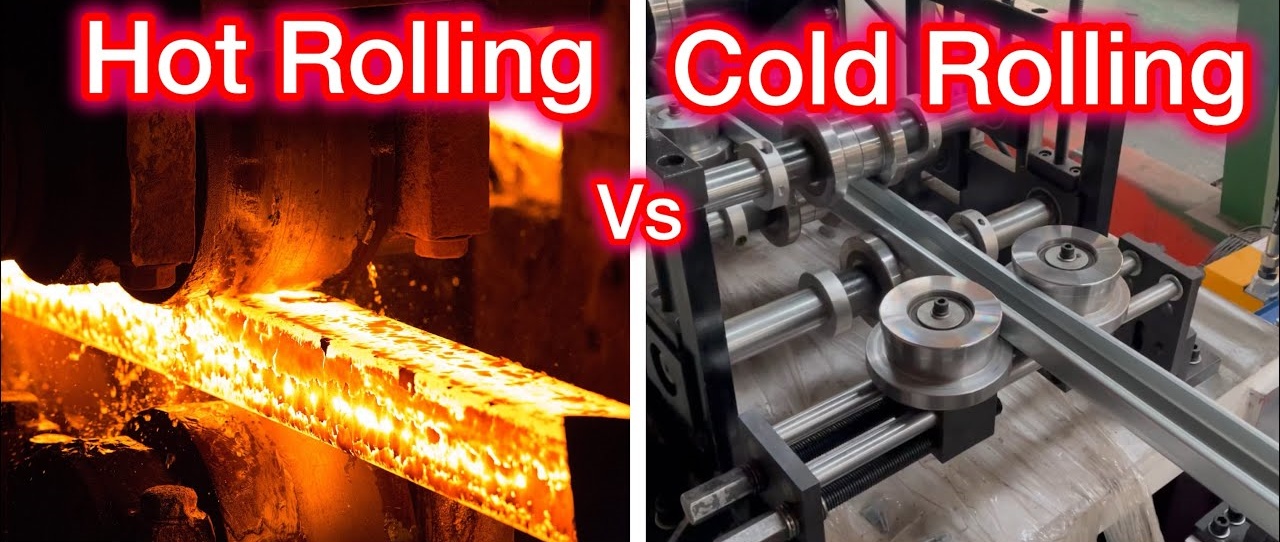 1.Appearance Characteristics
Hot-rolled steel: After high-temperature rolling, a layer of iron oxide scale forms on the surface, resulting in a rough surface. This surface is noticeably uneven and may even feel grainy. Furthermore, the presence of iron oxide scale causes the surface color of hot-rolled steel to appear darker, often bluish-black or brown.
Cold-rolled steel: This is produced by further rolling hot-rolled steel at room temperature. The surface is free of iron oxide scale, resulting in a smooth, mirror-like finish. It feels smooth to the touch and has a brighter, typically silvery-white color.
Hot-rolled steel plate: During the rolling process, due to factors such as high temperature, its edge is generally thicker and may not be very regular, and even burrs may appear.
Cold-rolled steel: After multiple cold-rolling passes, the edges of cold-rolled steel are relatively thin and regular, without noticeable burrs.
2.Dimensional Accuracy
Hot-rolled steel plate: During high-temperature rolling, factors such as thermal expansion and contraction of steel and the rolling equipment used result in relatively large thickness tolerances and poor flatness, potentially exhibiting some wavy or camber.
Cold-rolled steel plate: The cold rolling process allows for more precise control of the plate's thickness and shape. Consequently, cold-rolled steel plate exhibits uniform thickness, high dimensional accuracy, and excellent flatness. The thickness tolerance is typically controlled within ±0.01mm.
3. Mechanical Properties
Hot-rolled steel plate: Due to the high rolling temperature, the recrystallization process is complete, resulting in relatively coarse grains and a looser structure. Consequently, its hardness and strength are relatively low, but its toughness is relatively good. In a simple bend test, if the steel plate bends easily and there are no obvious cracks at the bend, it is most likely hot-rolled.
Cold-rolled steel plate: Rolling at room temperature produces work hardening, which significantly increases the hardness and strength of the steel plate, but reduces its toughness. In the same bend test, cold-rolled steel plate is more difficult to bend and is more prone to cracking at the bend.
Hot-rolled steel plate: It has good ductility and can be stretched, bent, and processed within a certain range without breaking.
Cold-rolled steel plate: Due to work hardening, its ductility is lower than that of hot-rolled steel plate. Excessive stretching or bending can easily cause the steel plate to crack.
4. Processing Marks
Hot-rolled steel sheets also have rolling marks, but they are less noticeable due to the rough surface and the presence of iron oxide scale.
Cold-rolled steel sheets have a smooth surface, with clearly visible rolling marks.
5. Processing Performance:Hot-rolled steel sheet: Suitable for simple cutting and bending processes, and is particularly well-suited for the production of structural parts requiring less-precision precision. However, due to its rough surface, it is prone to cracking during precision stamping.
Cold-rolled steel sheet: Due to its excellent dimensional accuracy and surface quality, it is well-suited for precision stamping and drawing processes, such as automotive body panels and appliance housings. However, excessive deformation during processing can lead to cracking due to work hardening, often requiring annealing to restore its plasticity.
Other MethodsSpark Identification: Grind the steel plate with a grinder and observe the sparks produced. Hot-rolled steel, due to its relatively low carbon content, produces sparse, elongated sparks. Cold-rolled steel, due to its work-hardening process and relatively high carbon content, produces denser sparks and more frequent cracking. However, this method requires experience.
Magnetic Testing: Generally speaking, for identical materials, cold-rolled steel, due to its denser structure, has slightly stronger magnetic properties than hot-rolled steel. However, this difference is subtle and requires the use of more sophisticated magnetic measuring instruments for accurate determination.


